
As a new school year begins, many parents naturally focus on:
“Will my child achieve better grades this year?”
“Will they complete their homework on time? ”
“Will they get into a good university?”
These questions matter.
But as artificial intelligence (AI) transforms the way we learn, work and live, perhaps parents should also ask a bigger question:
“Are we preparing our children for the world they will enter after graduation—not just the world that we understand today?”
The World Economic Forum (WEF) report “Shaping the Future of Learning: Education Readiness for the Age of AI” highlights that AI is transforming how people learn, access knowledge and develop skills.
However, the report also reminds us that “education will not be determined by technology alone.” “The future of learning depends on ensuring that innovation strengthens human learning, trust and development.” (World Economic Forum)
The challenge for parents is not predicting exactly what jobs will exist in 2035.
It is helping children develop the abilities to adapt, create and continue learning throughout their lives.

1. The Ability to Keep Learning
In a world where knowledge changes rapidly, the most valuable skill may not be knowing all the answers.
It may be knowing: How to learn. How to ask better questions. How to adapt when the world changes.
The World Economic Forum (WEF) report emphasises that AI readiness requires more than technology adoption. It requires developing the capabilities that allow learners to engage with change responsibly and effectively. (World Economic Forum)
What parents should reflect on:
Are we rewarding only correct answers?
Or are we helping children develop curiosity, independence and confidence in learning?
Parents can encourage children to:
- Ask “why?” and “what if?”
- Explore beyond textbooks
- Learn from mistakes
A child who knows how to learn will always have the ability to grow.
2. Critical Thinking: Learning to Question and Evaluate
AI can provide answers instantly.But children need to learn how to think before they accept those answers.
They need to ask:
- Is this information reliable?
- What evidence supports it?
- What perspectives are missing?
- When should I trust technology, and when should I question it?
The WEF report highlights that education in the AI era must consider not only access to technology, but also how learners develop judgement, responsible use and deeper understanding. (World Economic Forum)
What parents should reflect on:
When your child uses AI, are we asking: “Did AI give you the answer?”
Or: “How did you evaluate the answer?”
The goal is not to prevent children from using AI.
The goal is to help them become thoughtful users of technology.

3. Creativity: Moving from Consumption to Creation
AI can generate text, images and ideas.But creativity remains deeply human.
The ability to imagine possibilities, connect different ideas and create something meaningful will become increasingly valuable.
The WEF report highlights that AI should support learning while protecting human capabilities and development. (World Economic Forum)
What parents should reflect on:
Are children spending more time simply looking just for information, or are they creating something new for themselves?
Parents can encourage children on writing, designing, building projects, and exploring interests beyond the curriculum.
Creativity grows through curiosity, experience and experimentation.
It cannot simply be downloaded.
4. Communication and Collaboration: Working With Others
The future workplace will not only require individual talent.
It will require people who can:
- Communicate clearly
- Listen actively
- Work with people who have different perspectives
- Work effectively with others
Even as AI becomes more powerful, human connection remains essential.
What parents should reflect on:
Beyond academic achievement, are we helping children develop the confidence to:
- Express their ideas?
- Work with others?
- Understand different perspectives?
A child’s ability to connect with others will shape their opportunities in the future.

5. Resilience and Adaptability: Thriving Through Change
The future will bring uncertainty.
Children may enter different careers that continue to evolve throughout their lifetimes.
The ability to adapt may become more important than preparing for one specific destination.
The WEF report emphasises the importance of education systems in preparing learners for an AI-enabled future by building the foundations needed for ongoing growth and adaptation. (World Economic Forum)
What parents should reflect on:
When children face difficulties, do we immediately solve problems for them?
Or do we help them develop the confidence to overcome challenges?
Resilience is built through experiences:
Trying. Failing. Reflecting. And trying again.
6. Human Values and Ethical Judgement: What Makes Us Human
As AI becomes more powerful, uniquely human qualities become even more important.
Children will need responsibility, empathy, integrity, and ethical decision-making.
Technology can provide information.
But humans decide how that information should be used.
The WEF report reminds us that the future of education is not only about technological capability, but about ensuring AI strengthens human learning and trust. (World Economic Forum)
What parents should reflect on:
Are we preparing children only to be successful?
Or are we helping them become responsible people who can contribute positively to society?
From Academic Success to Future Readiness
The world of 2035 is difficult to predict.
But one thing is clear: Children will need more than knowledge.
They will need the confidence to keep learning, the ability to adapt, and the character to make meaningful decisions.
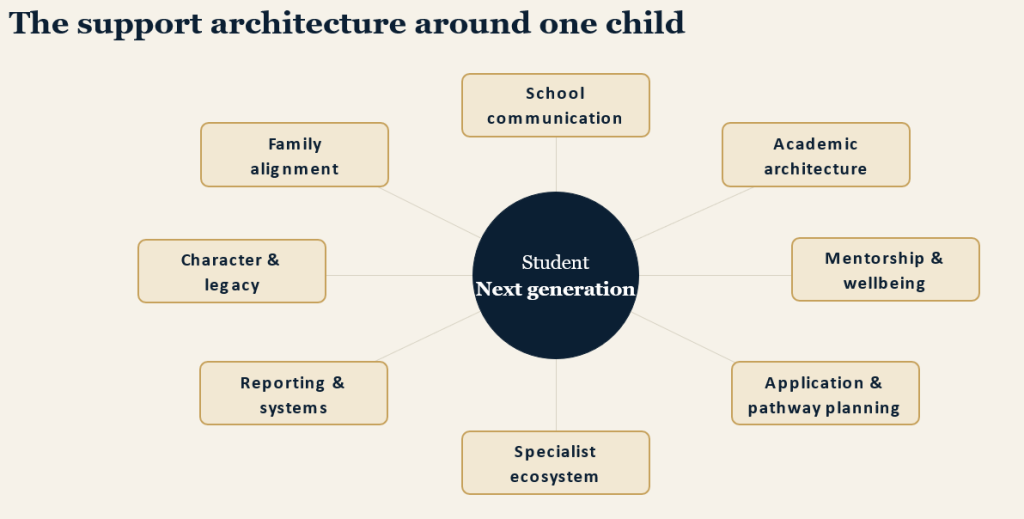
At BeGo, we believe education is not about preparing children for one exam, one university application or one career.
It is about building the invisible architecture behind lifelong growth.
This includes:
- Strong learning habits
- Trusted mentors
- Supportive relationships
- Meaningful experiences
- Long-term guidance
Because the greatest achievement is not simply preparing children for the future.
It is helping them become capable of shaping it.

Back-to-School Reflection for Parents
As the new academic year begins, perhaps the most important question is not:
“How can my child achieve higher grades more this year?”
But:
“How can I help my child become more capable of facing the future?”
AI is changing how we access knowledge, how we learn, and the skills that future work will require.
We don’t know exactly what the world will look like in 2035,nor can we predict what new careers will emerge.
But we can start today by helping our children develop the ability to face the unknown, adapt to change, and continue growing.
Because the best preparation is not about predicting the future.
It is about helping children develop the ability to create it.
Be empowered. Go beyond.